
Trolley
You have no items in your shopping cart

 Budgets
 Dumbers
 Discs
Discs
 Benches
 Racks and Rigs
 Weights Holders
 Isotonic machines
 Calisthenics
 Cardio
 Kettlebells
 Flooring
 Gym Set
 Accessories
 Combat
 ARTI MARZIALI
 CONTAINER GYM
 Tug-Of-War
 Used Gym Equipment
 PILATES MACCHINARI
 GINNASTICA ARTISTICA
 CAMPI DA PADEL
 Prodotti in Pronta Consegna
 Informazioni
 IRONMAN
 Gift Card
- Donatif
- General information
- 0 I like it
- 486 Views
- 0 comments
- gym flooring, safety flooring, gym safety, shock-absorbing materials
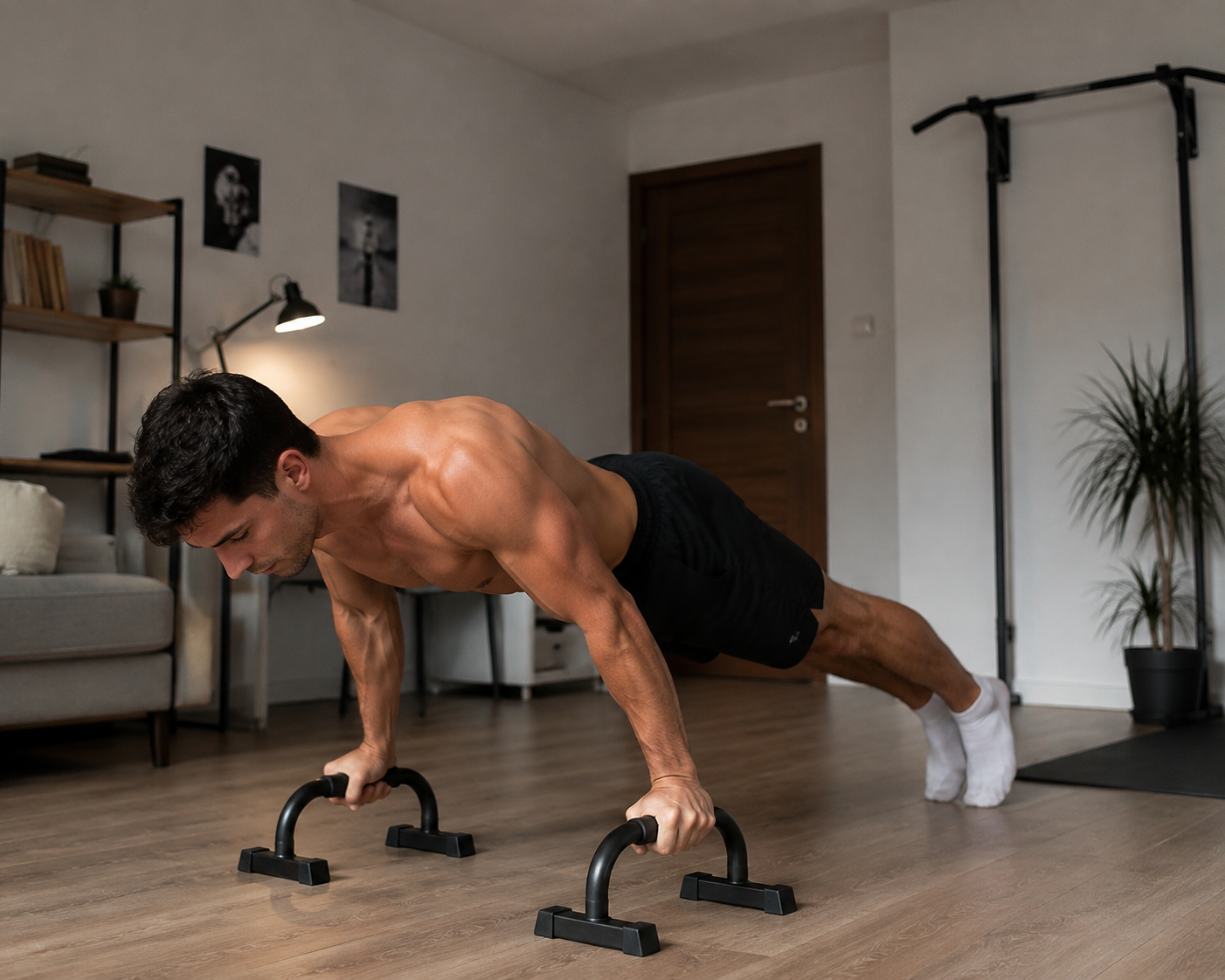
Calisthenics Training at Home: How to Set Up a Professional Space
Calisthenics training at home is an increasingly popular solution for those who want to train consistently without depending on gym schedules. Creating a dedicated space within your own home allows you to save time, improve consistency, and build a motivating environment where every session becomes easier to fit into your daily routine.
To achieve results truly comparable to those of a professional facility, however, it is not enough to just buy a pull-up bar or a few parallel bars. The design of the space, the quality of the equipment, and the possibility of expanding the station over time are determining factors in ensuring safety, comfort, and progression of exercises.
In this guide, we analyze how to design a home gym dedicated to calisthenics, which tools to choose, how to organize the available space, and which features to prioritize to make an investment destined to last for years.
- Why create a home calisthenics gym
- How to organize the space
- Essential equipment
- The importance of modularity
- Safety during training
- Programming workouts
- How to choose quality equipment
- Evaluating the long-term investment
Why create a home calisthenics gym
Training at home means eliminating many of the obstacles that often compromise continuity: traffic, travel time, crowded rooms, and time limitations. Having a dedicated area allows you to start a session in just a few minutes.
Those who train regularly know that consistency is the main factor for success. Having equipment always available increases the probability of sticking to your weekly schedule even on the busiest days.
A well-organized environment also improves concentration and allows you to dedicate yourself exclusively to the quality of technical execution.
Train whenever you want
The flexibility of hours allows you to perform sessions early in the morning, during your lunch break, or in the evening without any external constraints.
Reduce downtime and travel
Eliminating travel allows you to recover numerous hours each month, time that can be invested in training or recovery.
How to organize the space
It is not necessary to have a garage or a dedicated fitness room. Even a small room can be transformed into a highly functional gym if designed with care.
It is important to evaluate the ceiling height, the distance from the walls, and the area necessary to perform dynamic exercises without limitations.
Good lighting, adequate flooring, and proper ventilation improve comfort and safety during every session.
How much space is really needed
In most cases, a few well-organized square meters are enough to train strength, mobility, and body control.
Organizing equipment
Arranging tools in an orderly manner makes transitions between exercises more fluid and improves the overall experience.
Essential equipment
The choice of equipment determines the quality level of the entire training space. Investing in sturdy and certified structures allows you to train with greater safety.
Home calisthenics equipment designed with quality materials ensures stability even during advanced exercises like muscle-ups, front levers, and human flags.
Among the fundamental elements are the pull-up bar, parallel bars, gymnastic rings, dip station, and modular systems that allow for future expansions.
How to choose the best home pull-up bar
The stability of the structure, the diameter of the grip, and the quality of the welds directly affect the user experience.
Parallel bars and accessories
Parallel bars allow you to enormously expand the number of available exercises, improving strength and control.
The importance of modularity
A modular structure is a smart choice because it allows you to start with an essential configuration and expand it over time.
This feature allows you to adapt your home gym to your goals without completely replacing existing equipment.
Professional systems also facilitate the integration of new accessories while maintaining high structural stability.
Gradually expand the station
Adding new elements only when necessary allows you to distribute the investment while maintaining high quality.
Adapt to progress
As your capabilities improve, it will be possible to add more advanced equipment without redesigning the entire area.
Safety during training
Every component must be installed correctly following the manufacturer's instructions and periodically checking the tightening of the elements.
The use of anti-shock flooring helps reduce the risk of injury and protects the home floor.
Construction quality is particularly important during explosive exercises and dynamic movements.
Correct installation
A professionally fixed structure offers greater stability and provides more confidence during training.
Periodic maintenance
Periodically checking bolts, fasteners, and surfaces allows you to maintain high performance over time.
Programming workouts
Having a home gym facilitates the planning of short but frequent sessions, a fundamental element for improving in calisthenics.
Alternating pushing, pulling, core, and mobility exercises allows for harmonious strength development.
Progressive training allows you to tackle increasingly complex movements while maintaining high technical quality.
Create an effective routine
Establishing fixed days and times significantly increases the probability of sticking to the program.
Monitor improvements
Recording repetitions, hold times, and new exercises helps keep motivation high.
How to choose quality equipment
When evaluating a purchase, it is appropriate to consider materials, finishes, warranty, support, and customization possibilities.
Professional structures built with high-thickness steel ensure greater durability even after years of intensive use.
Investing from the beginning in a well-designed indoor calisthenics gym avoids premature replacements and improves the daily experience.
Materials and workmanship
Powder-coated steel, quality welds, and certified components are fundamental features.
Evaluate the price-quality ratio
The initial cost should be analyzed together with the expected lifespan, stability, and the possibility of future expansion.
Evaluating the long-term investment
Creating a space dedicated to calisthenics training at home means investing in your own consistency and the quality of your daily workouts.
Careful design, the purchase of professional home calisthenics equipment, and the choice of modular systems allow you to create an environment destined to accompany the athlete's growth for many years.
For those who want to train every day without compromise, focusing on reliable materials, solid structures, and expandable components represents the most effective solution for achieving lasting results and building a truly professional home gym.
Comments (0)