
Trolley
You have no items in your shopping cart

 Budgets
 Dumbers
 Discs
Discs
 Benches
 Racks and Rigs
 Weights Holders
 Isotonic machines
 Calisthenics
 Cardio
 Kettlebells
 Flooring
 Gym Set
 Accessories
 Combat
 ARTI MARZIALI
 CONTAINER GYM
 Tug-Of-War
 Used Gym Equipment
 PILATES MACCHINARI
 GINNASTICA ARTISTICA
 CAMPI DA PADEL
 Prodotti in Pronta Consegna
 Informazioni
 IRONMAN
 Gift Card
- Donatif
- General information
- 0 I like it
- 10 Views
- 0 comments
- gym flooring, safety flooring, gym safety, shock-absorbing materials
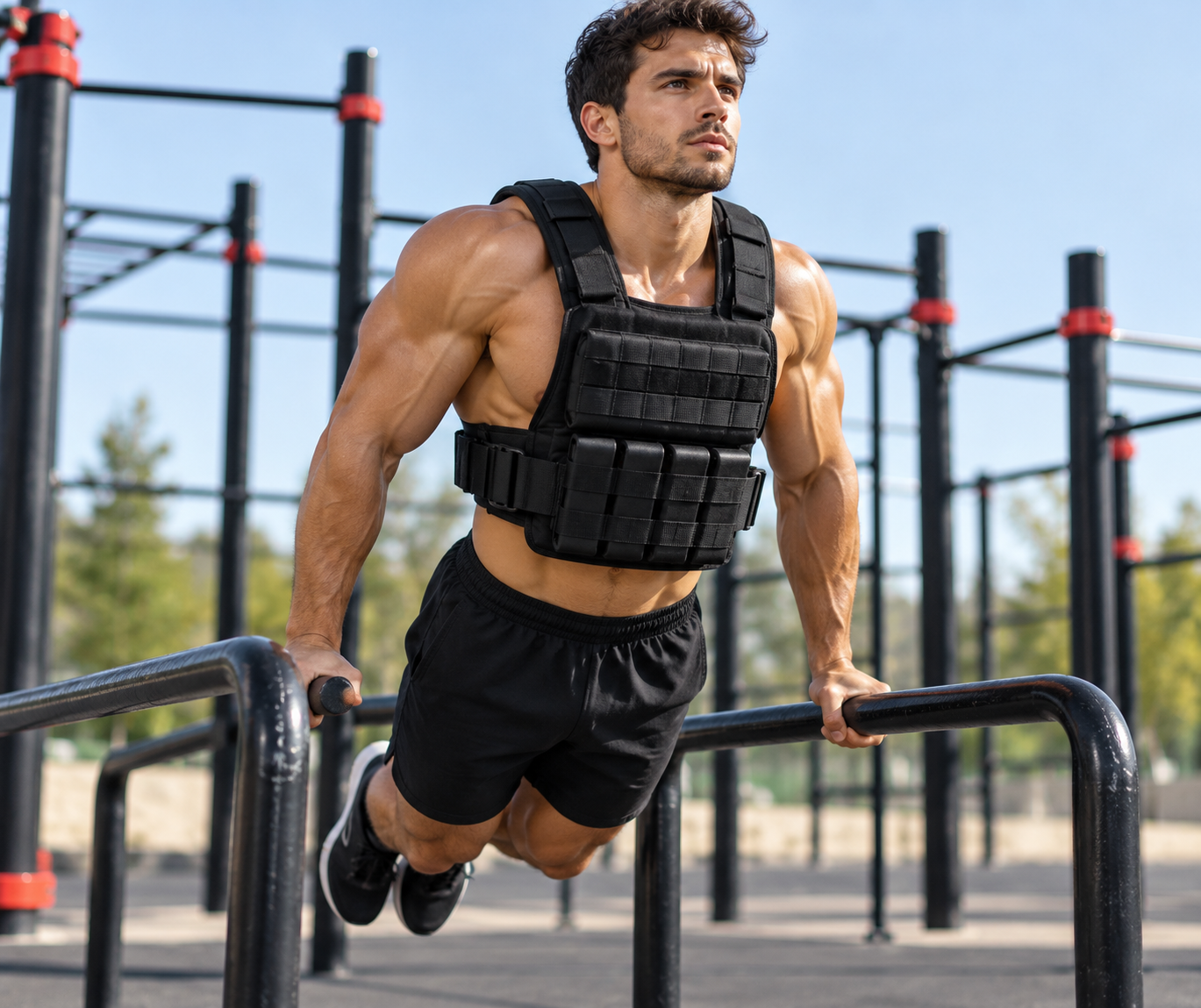
Weighted vest for calisthenics: requirements and usage
A weighted vest for calisthenics means using a weighted vest to progressively increase the load during bodyweight exercises like pull-ups, push-ups, dips, and squats. The correct choice depends on fit, weight adjustment, stability during movement, and the ability to maintain flawless technique. Before increasing the load, it is always necessary to master bodyweight exercises.
The weighted vest is one of the most widely used tools for applying the principle of progressive overload in calisthenics without altering exercise mechanics. Unlike other weighting systems, it distributes the weight across the torso, allowing you to keep your hands free and perform complex movements with greater continuity.
This guide analyzes how to choose a weighted vest, what weight to use, when to prefer an adjustable or fixed model, what errors to avoid, and how to incorporate it into an effective routine. The indications provided constitute practical evaluation criteria and do not replace the instructions of the device manufacturer used.
- What a weighted vest is
- What requirements it must have
- How much it should weigh
- Adjustable or fixed
- How to use it
- Errors and safety
- Alternatives to the weighted vest
- How to evaluate the investment
What is a weighted vest for calisthenics?
A weighted vest is a vest designed to hold evenly distributed weights on the torso. The goal is to increase the external load without significantly altering the user's center of gravity. In calisthenics, it is mainly used to increase the difficulty of foundational exercises when body weight alone is no longer a sufficient stimulus.
The effectiveness of the system depends on the quality of the fit. A stable vest limits weight shifting during jumps, pull-ups, or push-ups, reducing oscillations that can compromise technique.
For specific workouts, it is important to choose a product compatible with the range of motion required by the discipline. A model that is too bulky can interfere with shoulder mobility or scapular position.
How it works
The principle is simple: by increasing the total load, the mechanical demand on the involved muscles also increases. This allows you to progress while maintaining the same movement patterns of already familiar exercises.
For which exercises it is suitable
It is commonly used for pull-ups, dips, push-ups, squats, lunges, walks, step-ups, and other movements where body control remains a priority over absolute load.
What requirements must a weighted vest have?
The choice should be based on verifiable criteria rather than exclusively on the declared maximum weight.
The main aspects to evaluate are fit, even weight distribution, quality of stitching, wear-resistant materials, reliable closure systems, and adjustment possibilities.
For those wishing to gradually increase the load, it is preferable to consider an adjustable weighted vest that allows small increments without replacing the entire product.
Fit
The vest must adhere to the torso without excessively restricting breathing. During explosive movements, it should neither shift nor generate continuous bouncing.
Materials and construction
Durable fabrics, reinforced seams, and padding at contact points improve comfort and durability. It is also useful to check the ease of cleaning and maintenance indicated by the manufacturer.
How much should a weighted vest weigh?
There is no universal value valid for everyone. The choice depends on the athlete's experience, the exercise performed, the programming goals, and the ability to maintain correct technique.
In practical terms, it is best to start with moderate increments, verifying that each repetition maintains complete control of the movement. Only after several sessions without technical alterations is it appropriate to increase the load.
The progressive approach reduces the risk of overloading joints and tissues when the body is not yet adapted.
Progressive increments
Small increases allow for better performance monitoring and identification of the truly sustainable load level. Excessive increments can compromise the quality of the movement and recovery.
Training objective
For strength, endurance, or conditioning, the load is handled differently. It is therefore useful to program weight, volume, and frequency based on the desired result.
Better an adjustable or fixed weighted vest?
The answer depends on the type of use. An adjustable model offers greater flexibility because it allows you to quickly modify the available weight.
A fixed model can be simpler, more compact, and immediate when the desired load remains constant over time.
For those anticipating continuous progression or shared use among people with different levels, the adjustable system often represents the most versatile solution.
Advantages of the adjustable vest
It allows for gradual adjustments, greater customization, and use on different exercises without purchasing multiple vests.
Advantages of the fixed vest
It can offer a more compact structure and reduced preparation times, making it practical when the weight does not need to be modified frequently.
How to use the weighted vest safely?
Before introducing the weight, it is advisable to perform each exercise with consolidated bodyweight technique. Overload should not compensate for deficiencies in motor control.
Warming up maintains a fundamental role. Joint mobility, muscle activation, and preparatory sets help manage the transition from body weight to additional load.
During the workout, it is appropriate to interrupt the set when technique begins to deteriorate instead of chasing exclusively the number of repetitions.
Use in pull-ups
In pull-ups, the vest must stay close to the torso, avoiding oscillations that alter the rhythm of the movement. Full range of motion remains a priority.
Use in push-ups
In push-ups, it is important to maintain torso alignment. A stable vest distributes the load without creating excessive pressure points.
What errors to avoid and what safety aspects to consider?
The most frequent error consists of increasing the weight too quickly. Improvement in calisthenics stems from steady progression rather than sudden increments.
Another error concerns choosing a vest that is too loose. The continuous shifting of the weight can alter movement control and increase discomfort during the session.
It is also advisable to periodically check the condition of buckles, seams, and fastening systems by following the manufacturer's maintenance instructions.
Technique before load
If the movement loses precision, it is preferable to reduce the weight rather than continue with incorrect executions.
Equipment checks
Before each use, verify that the weighted elements are correctly inserted and that the closures are completely locked.
Are there alternatives to the weighted vest?
In some situations, it is possible to use other overload systems such as the dip belt, particularly widespread in pull-ups and dips, or dumbbells and barbells when the training program allows it.
Weighted ankle weights have different applications and do not represent a direct substitute for the vest in main calisthenics exercises.
For those wishing to learn more about equipment dedicated to the discipline, the calisthenics equipment category is available, useful for evaluating the various solutions available.
When to prefer a dip belt
The belt can be suitable in vertical pulling exercises when you want to concentrate the load lower down without increasing bulk on the chest.
Choice based on context
Home training, functional boxes, and gyms may require different characteristics in terms of modularity, available space, and frequency of use.
How to evaluate the investment in a weighted vest?
The decision should consider expected durability, build quality, availability of replacement parts, ease of adjustment, and comfort during repeated sessions. A well-designed vest maintains stability even with frequent use and allows for orderly progression over time.
For a private user, it is often useful to prioritize versatility and simplicity of adjustment. For a gym or sports center, robustness, ease of sanitization, speed of adaptation between different users, and resistance to intensive use also become relevant.
Before purchasing, it is advisable to compare load capacity, mass distribution, closure system, compatibility with intended exercises, and manufacturer indications. When applicable, it is appropriate to consult technical manuals, user instructions, and manufacturer documentation, which represent primary sources for usage limits, maintenance, and operating methods. An approach based on verifiable criteria allows you to choose equipment consistent with training goals while avoiding purchases guided exclusively by the declared maximum weight or commercial features devoid of real practical utility.
FAQ: Does the weighted vest replace the barbell?
No. The weighted vest increases the load in bodyweight exercises but does not replace the characteristics of exercises with traditional overloads.
FAQ: When to increase the weight?
The increase is appropriate when all scheduled sets are completed with stable technique, movement control, and adequate recovery in subsequent sessions.
Comments (0)