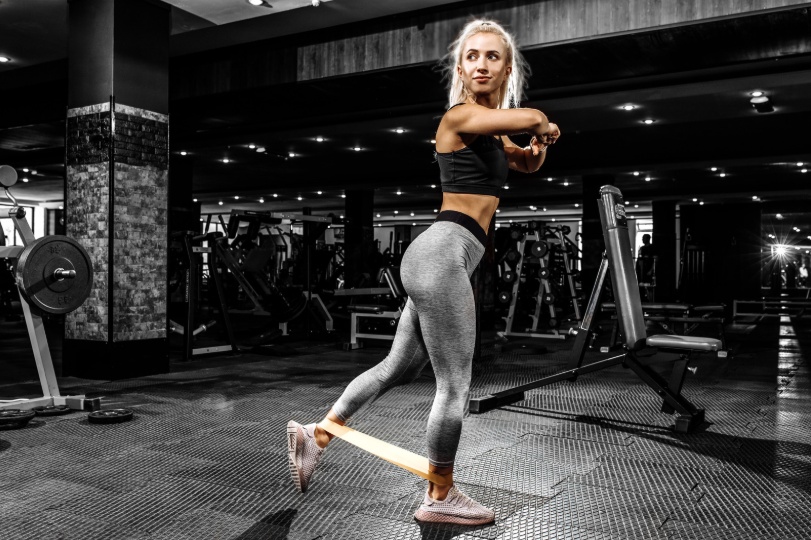
For many recreational runners, the problem is not just running more, but running better without accumulating aches in the knees, hips, calves or lower back. Resistance bands for runners are simple, compact and very useful tools for working on stability, control and muscle activation. They do not replace a well-structured training program, but they help prepare the body for the repetitive demands of running.
Used correctly, mini bands and power bands allow you to add targeted exercises before running, on strength days or during active recovery phases. The goal is not to look for spectacular movements, but to choose exercises that match the runner's movement: hip control, knee alignment, stability on landing, and the ability to absorb and return force more efficiently.
Why resistance bands are useful in runner training
Resistance band exercises for runners are effective because they create progressive, easily controlled resistance. Unlike many traditional loads, the band increases tension as it is stretched, forcing the runner to control the movement all the way to the end. This is valuable for anyone who tends to lose control as fatigue builds, especially during long runs or quality sessions.
Another advantage is the ability to work on small but decisive movements. Running is made up of repeated landings, pushes, braking and micro-adjustments. If the hip, knee and foot are not communicating well, the load can always concentrate on the same areas. Bands help make the movement more conscious, improving activation of the stabilizing muscles without turning the session into a complex or hard-to-manage workout.
Hip stability and knee control in running
Hip stability is one of the most important topics for runners. When the pelvis loses control, the knee can collapse inward and the landing becomes less efficient. This does not mean every issue comes from the hip, but targeted work on the glute medius, rotators and lateral control can help many runners distribute forces better while running.
Hip resistance band exercises are particularly useful because they train exactly these mechanisms. Lateral walks with mini bands, controlled knee openings and single-leg holds with elastic resistance teach the body to maintain alignment and stability. Quality of execution matters more than quantity: if the knee wobbles, the pelvis drops or the foot loses stable contact, it is better to reduce tension and restart with a cleaner movement.
The role of glutes, pelvis and foot contact
The glutes are not just for "pushing"; they contribute to pelvic control in every phase of the landing. For a runner, this control can make the difference between a fluid stride and a run that puts excessive stress on the knee or the outer thigh. The band makes it obvious when a movement is being compensated, because even light resistance reveals instability or asymmetries.
A simple exercise is the lateral walk with a mini band placed above the knees or at the ankles. The runner keeps the torso stable, knees slightly bent, and takes controlled side steps without letting the knee cave inward. This is not an exercise to perform quickly: the benefit comes from precision, constant tension and the ability to keep the pelvis still.
Mini band exercises for preventing overload
Mini bands are suited to activation, stability and motor control exercises. Before running, they can be used to prepare the glutes and hips, while on light strength days they can become part of a more complete routine. For a recreational runner, a useful sequence can include lateral walks, monster walks, glute bridges with knee opening and controlled band squats.
These movements support running injury prevention only when they are introduced with progression and attention. The goal is not to feel a burn at all costs, but to improve the ability to maintain control under load. Anyone with significant pain or persistent symptoms should avoid aggressive DIY training and consult a professional, because an exercise that is right for one runner may be premature or unsuitable for another.
Lateral activation and single-leg control
Single-leg control is central because running is essentially a series of single-leg landings. A useful exercise is balancing on one foot while a mini band creates a light lateral pull. The runner must stay stable, breathe, keep knee and foot aligned, and control the pelvis without stiffening up.
Another effective variation is the partial single-leg squat, performed with a reduced range and maximum technical precision. There is no need to go very deep: controlling a few centimeters of bending without letting the knee collapse is enough. This type of work prepares the body to better tolerate the demands of running, especially when volume, pace or elevation increase.
Power band exercises for elastic strength and muscle return
Power bands offer higher resistance and are better suited to strength, assistance or controlled elastic work. For runners, they can be used for assisted pulls, resisted lunges, hip extensions, calf exercises and elastic return movements. Their value lies in creating directional tension that mirrors the sporting movement without immediately loading with heavy weights.
In performance work, it is important to avoid excessive promises. Bands do not automatically make you faster, but they can help improve movement quality, reactivity and force management. A runner who controls landing better and wastes less energy may feel that their running is more efficient, especially when these exercises are combined with good technique, recovery and proper programming.
When to include them in your weekly routine
Band exercises can be placed before a run as a short activation, or away from the more intense sessions as complementary work. Before an easy run, a few minutes with mini bands are enough to wake up the glutes and stabilizers. On strength days, a power band can be used for more structured and controlled exercises.
A balanced routine should not tire the runner before they run. If the goal is activation, the volume stays low and the final sensation should be greater control, not fatigue. If the goal is strengthening, it is best to separate the work from the more demanding sessions, so that quality is maintained both in running and in the exercises.
How to build a safe and progressive routine
A practical routine can be built around three parts: hip activation, single-leg control and elastic pushing work. For example, the runner can start with lateral walks using a mini band, continue with single-leg holds and finish with hip extensions or assisted lunges using a power band. Each exercise should be performed with controlled movement, steady breathing and attention to alignment.
Progression should be gradual. First improve movement quality, then increase the number of repetitions and only afterwards the band resistance. This approach reduces the risk of turning preventive work into a new overload. For runners who train consistently, resistance bands for runners are a concrete, accessible and versatile tool to protect the body, improve stability and build a stronger foundation for performance.


 Budgets
 Dumbers
 Discs
 Benches
 Racks and Rigs
 Weights Holders
 Isotonic machines
 Calisthenics
 Cardio
 Kettlebells
 Flooring
 Gym Set
 Accessories
 Combat
 ARTI MARZIALI
 CONTAINER GYM
 Tug-Of-War
 Used Gym Equipment
 PILATES MACCHINARI
 GINNASTICA ARTISTICA
 CAMPI DA PADEL
 Prodotti in Pronta Consegna
 Informazioni
 IRONMAN
 Gift Card