The regulation padel court dimensions are 10 metres wide by 20 metres long, measured inside the walls: that is 200 m² of playing area alone. The site, however, must be larger, because the court structure, the space around the court, the entrance and, if needed, the clear height for a roof must all be added to that rectangle.
For this reason, the useful question is not “how big is a court?” but “how much space does the project need?” Those who ask only once the design is underway risk discovering too late that a side, an access point or a height is missing.
Here you will find a method for checking the feasibility of the site: what to measure, in what order, and which data to request from the supplier. There are no invented figures for ancillary spaces: they depend on the chosen model, the designer and local regulations.
In this article
What is the standard size of a padel court?
The International Padel Federation (FIP) regulations specify a playing area of 10 x 20 metres. These are internal dimensions, measured between the inner faces of walls and glass. Before a final design, always check the current version of the regulations on the federation’s official website.
This applies to the standard doubles padel court. If you come across proposals for single courts or reduced formats, treat them as manufacturer-specific configurations and request the dimensions from the technical datasheet.
Among catalogue courts, the rectangle changes very little, while the structure enclosing it changes a great deal. You can find the different configurations in the padel courts category.
Why is the playing rectangle not enough?
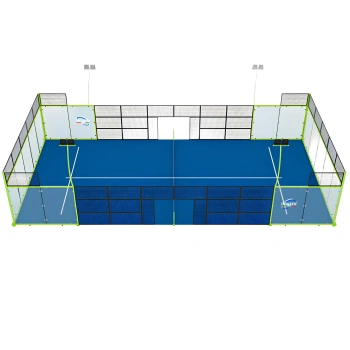
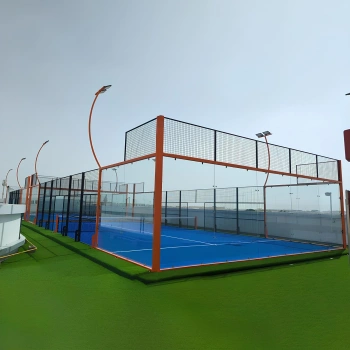
Because 10x20 m describes only what lies inside. The court is surrounded by a structure of panels, glass, posts and wire mesh, which occupies floor space. Around it you also need free space to move, carry out maintenance and exit safely.
The risk is anchoring the project to the minimum measurement: the area “fits” on paper, but the court cannot actually be assembled. This happens most often when planning is done by eye on a plot of land or in a courtyard.
The elements the rectangle does not include are:
- the floor footprint of the perimeter structure;
- free space around the court for maintenance and circulation;
- the entrance (court door) and the path leading to it;
- any lighting poles or roof supports;
- vehicle access and space for assembly, often overlooked.
From court to site: how is it calculated?
The calculation is additive. Start with the playing area, add the footprint of the structure on each side, then add the perimeter spaces required by the project. The result is the minimum width and length of the site.
| Item | Width | Length | Where to find the data |
|---|
| Playing area | 10 m | 20 m | FIP regulations |
| Structure footprint | + thickness on both sides | + thickness on both ends | Model technical datasheet |
| Perimeter and maintenance space | + to be defined | + to be defined | Supplier and designer |
| Access and circulation | + to be defined | + to be defined | Designer, local regulations |
| Minimum total site | sum | sum | Final check with the supplier |
If the site is an irregular rectangle, verify that the entire court fits with all required spaces, not just on the diagonal or at a single point. A sloping side or a fixed obstacle can invalidate the calculation.
Configuration: how many courts on the same site?
If you plan several courts, the figures change: some elements (walkways, entrances, facilities) can be shared, others cannot. Do not simply multiply the site for one court by the number of courts: ask the designer for an overall layout plan.
Clear heights: outdoor, covered, indoor
Padel is also played with balls hit high, so clear height matters. Outdoors, check that there are no branches, cables, canopies or power lines above the court.
With a roof or inside a warehouse, the usable height is a genuine design constraint. Measure it to the lowest point (beams, services, light fittings), not to the ceiling. The regulations indicate a reference minimum clear height: check it in the official text and confirm it with the supplier and designer.
For an uncovered court that needs to be fitted out, dedicated solutions exist, such as the sports cover for padel courts, which changes the footprint and heights of the project: read the data on the model’s datasheet.
Site survey checklist
Before contacting a supplier, collect the following data. A laser measure or an up-to-date cadastral plan is enough, ideally verified by an on-site inspection.
- Measure the width and length of the area at several points, not just at the edges.
- Record the shape, corners, and any sloping or curved sides.
- Note fixed obstacles: walls, trees, poles, cabins, drains.
- Identify where the court entrance could be and how it will be reached.
- Record level changes and ground gradients.
- If indoor or covered, measure the clear height at the lowest point.
- Check how vehicles and materials will reach the site during assembly.
- Mark where underground services and cables run, if known.
- Take photos of the area from several angles.
For the surface, consider the type of flooring early on: synthetic turf with lines covers other uses, while turf for padel courts is available in the court datasheets. If you need a ready-to-go solution, also look at ready-to-ship structures, such as the Basic Pro padel court, and compare the footprints in the technical datasheet.
What to ask the supplier to confirm feasibility
With the survey in hand, your request becomes precise. Ask for:
- the total floor footprint of the model, structure included;
- the recommended free space around the court;
- the height of the panels and, if needed, of the roof;
- foundation or base surface requirements;
- what is included in the supply and what must be arranged separately.
Check every local constraint with the designer or the municipal technical office: distances, noise, lighting, permits. These issues vary from one municipality to another and should never be taken for granted.
If you have already read other guides on laying out sports areas, such as the space needed for an MMA cage or the area around a boxing ring, the reasoning is the same: from the equipment to its footprint, and from the footprint to the operational area. For a larger facility, you may also find the method for designing a functional layout useful.
Frequently asked questions
How many square metres does a padel court need?
The playing area is 200 m² (10x20 m). The site requires more: structure, perimeter spaces and access depend on the model and the project, so they must be confirmed by the supplier.
Is a 10x20 metre area enough?
No. That is the internal size of the court, but the structure takes up space, and you need free space and an access route. An area of exactly 10x20 m is not enough to install a court.
What minimum height is needed for an indoor padel court?
The official regulations give a reference clear height. Check the current text and confirm it with the designer and supplier, measuring from the lowest point of the ceiling, including services.
Can a padel court be installed in a private garden?
It depends on the space, the ground and local regulations. Start with a site survey, check the footprints on the model datasheet, and find out from the municipality which requirements apply.
Do the dimensions change between a panoramic and a traditional court?
The playing area is the same. What changes are the wall materials and therefore the structure’s footprint: read the datasheets of the individual courts.
Conclusion: measure before you design
To assess feasibility, consider three levels: the regulation playing area, the structure and perimeter spaces, and heights and access. With a survey and checklist, you will approach the supplier with clear data and targeted questions, reducing the risk of spending on design for a site that is not suitable.
Compare models in the padel courts category, or send Donatif your site measurements for a technical opinion: request a consultation or a quote.


 Budgets
 Dumbers
 Discs
 Benches
 Racks and Rigs
 Weights Holders
 Isotonic machines
 Calisthenics
 Cardio
 Kettlebells
 Flooring
 Gym Set
 Accessories
 Combat
 ARTI MARZIALI
 CONTAINER GYM
 Tug-Of-War
 Used Gym Equipment
 PILATES MACCHINARI
 GINNASTICA ARTISTICA
 CAMPI DA PADEL
 Prodotti in Pronta Consegna
 Informazioni
 IRONMAN
 Gift Card




Comments (0)