Football Floor
Category Introduction and Key Benefits
Choosing the floor for football fields means guaranteeing quality of play, athlete safety and management sustainability over time. A modern system combines mantle, underlay, shockpad and drainage solution to achieve consistent performance in every season. Whether it's an 11-a-side field, a multi-purpose center or a schoolyard, the right sports flooring optimizes bounce, traction and comfort, while reducing maintenance costs compared to traditional surfaces.
Our offer covers the entire spectrum: latest generation synthetic turf , rubber flooring for perimeter areas and indoor courts, hybrid systems and finishing accessories. Each solution is designed to respond to the level of users (competitive, amateur, school), the intensity of use and the local climate, following a design logic that starts from the analysis of the site and arrives at the certified installation , and then continues with simple and sustainable maintenance plans.
What is a football floor and when to choose it
A football floor is a sports system consisting of several layers: load-bearing base, elastic layer, playing surface and markings. You choose when you want a high-performance and reliable field all year round, regardless of rainfall or intensive use. It is ideal for sports clubs that host several teams, for public administrations with extended hours and for schools that alternate different activities on the same playing field.
Differences between professional, school and amateur use
Professional courts favor rebound precision, ball sliding and controlled traction; school contexts require greater versatility and safety for heterogeneous users; amateur ones focus on durability, ease of management and low costs. The yarn height, density, presence of shockpad, type of infill and specifications of the perimeter flooring therefore change.
Materials and technologies
The family of football floors includes synthetic turf with monofilament or fibrillated yarns, hybrid systems (natural + synthetic), and rubber flooring for indoor or multi-purpose areas. The technological heart is the mantle + shockpad combination, which returns shock absorption and stability. This is combined with efficient drainage that avoids stagnation, preserves the fibers and keeps the ball running constant.
The evolution of materials has led to soft-touch yarns, anti-UV treatments and stabilized colors, with reinforced backing structures and high-strength seams . Where more elasticity is needed, a continuous or roll layer of elastic is inserted, calibrated to different thicknesses to calibrate bounce, traction and comfort.
Latest generation synthetic turf
Modern football artificial turf employs "S", "C" or mixed section yarn profiles to combine resilience, visual naturalness and durability. The height of the turf and the density of fibers determine the behavior of the ball and plantar unloading; in high-use plants, a higher density is preferred, while in community camps the performance/cost ratio is optimized.
Rubber flooring and hybrid systems
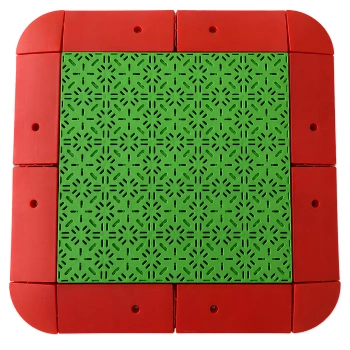
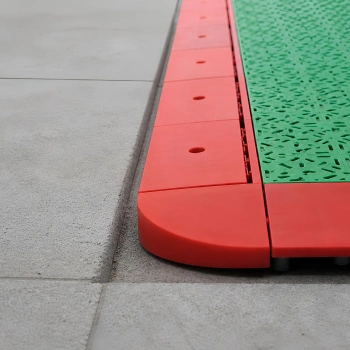
Rubber flooring is the ideal choice for gyms, indoor courts and perimeter areas: it offers non-slip, acoustic comfort and easy cleaning. Hybrid systems, on the other hand, combine naturalness and resistance, suitable for representative contexts or stadiums that require professional maintenance.
Subfloors, shockpads and drainage
Regular underlayment is the prerequisite of every football sports flooring. The shockpad modulates elasticity, while the vertical and horizontal drainage dissipates water while protecting the structure. The correct combination of these layers determines the service life of the system and the quality of play.
Performance, comfort and safety
For a high-performance court, shock absorption, controlled rebound and stable traction count when accelerating and changing direction. These parameters improve the gaming experience, lower the perception of fatigue and reduce the risk of micro-trauma. A non-slip football floor maintains grip even in wet conditions, preserving the fluidity of the actions.
Resistance to atmospheric agents and UV rays protects the aesthetics and structure of the mantle, while the shockpad limits peak loads on joints and ligaments. For intensive facilities, a plan of periodic field tests ensures consistent performance season after season.
Shock absorption, rebound and traction
The balance between elasticity and support is crucial: too much stiffness increases muscle stress, excessive softness penalizes the speed of the ball. A correctly sized system maintains bounce and traction in optimal ranges, enhancing individual technique and intensity of the game.
Non-slip, weather and UV resistance
Surface and composite treatments of the yarn increase tightness and reduce frictional wear. The anti-UV finishes protect colour and mechanical integrity, while the choice of suitable technical infills contributes to stability in rain and intense heat.
Installation, installation and maintenance
The installation of the football floor follows precise phases: site verification, preparation of the substrate, laying of the shockpad, installation of the turf, gluing and stitching, marking and testing. A clear timetable reduces unforeseen events and allows you to respect the weather windows. The construction management coordinates teams and supplies to deliver the plant on schedule.
Routine maintenance includes brushing, infill restoration, cleaning, and joint checks. Extraordinary interventions – such as the renovation of worn portions – extend the life of the field and maintain constant performance and safety. We provide maintenance plans calibrated on hours/year and level of play.
Installation phases and construction times
From the delivery of materials to final testing, every step is documented. Markings are positioned with millimeter tolerances to ensure correct field reading and alignment with doors and technical areas.
Ordinary and extraordinary maintenance
A program of periodic visits certifies the maintenance of the rebound, sliding and traction parameters. In the event of exceptional events, the intervention team quickly restores drains and seams, bringing the system back to its original values.
How to choose the right football floor
The choice depends on budget, intensity of use, athlete level and climate. A club with many teams will favor a system with shockpad and high resilience yarn; a school will be able to opt for more versatile and easy-to-maintain solutions. We analyze the site to propose combinations that maximize performance and durability.
We also evaluate energy availability, sun exposure, prevailing winds and water disposal. The result is a football pitch optimised in drying times, thermal comfort and annual management, with a TCO (total cost of ownership) under control.
Budget, intensity of use and level of users
For continuous competitive use, more stringent parameters on rebound and traction are needed; for the amateur, robustness and simplification of maintenance can be privileged. We include variants with comparative analysis in the quote.
Local climate and site constraints
In rainy areas, drainage is the priority; in very sunny areas, UV protection and surface temperature become critical. In noisy sites, the rubber floor helps to dampen the sound during indoor activities.
Certifications and reference standards
Our football sports flooring solutions are developed to meet the main quality programs and laboratory tests related to shock absorption, deformation, friction and strength. The technical documentation accompanies each supply, with batch traceability and maintenance manuals.
We promote sustainability criteria in the choice of materials, in the management of the end of life of the turf and in the reduction of water and energy consumption. Component traceability allows for quick audits and scheduled renewals.
Quality programs and laboratory tests
The samples are tested to verify yarn resilience, dimensional stability and consistency of rebound and traction over time. On request we provide updated reports for calls and accreditations.
Material traceability and sustainability
Each system is accompanied by technical data sheets and environmental declarations, with indications for correct recycling at the end of its life cycle. The goal is to reduce the impact and prolong the useful use of the field.
Frequently Asked Questions (FAQs)
How long does a synthetic turf football floor last?
Under normal use and regular maintenance , an artificial turf system can last 8–12 years. The service life depends on the intensity of use, the shockpad present, the climate and the quality of the substrate.
Is it also suitable for schools and multi-purpose centres?
Yes. Our football floors are designed to withstand a wide range of users and busy schedules, offering non-slip, comfort and easy cleaning, with indoor rubber and outdoor synthetic turf solutions.
What are the main maintenance activities?
Periodic brushing, infill restoration, seam and drainage checks, cleaning and seasonal inspections. We provide tailor-made plans with a calendar of interventions.


 Budgets
 Dumbers
 Discs
Discs
 Benches
 Racks and Rigs
 Weights Holders
 Isotonic machines
 Calisthenics
 Cardio
 Kettlebells
 Flooring
 Gym Set
 Accessories
 Combat
 ARTI MARZIALI
 CONTAINER GYM
 Tug-Of-War
 Used Gym Equipment
 PILATES MACCHINARI
 GINNASTICA ARTISTICA
 CAMPI DA PADEL
 Prodotti in Pronta Consegna
 Informazioni
 IRONMAN
 Gift Card