Hockey Floor
The hockey floor is the invisible element that defines the rhythm, safety and fluidity of every game. A professionally designed surface ensures consistent grip, controlled spring response and predictable puck or wheel rolling, allowing athletes to express technique and speed in total control. Whether it's roller hockey, inline hockey or indoor courts, the choice of coating makes tangible differences: fewer unwanted slides, more precise stops, quick changes of direction and a safer playing experience for everyone, from school training to tournaments.
On this page you will find a complete guide to orient yourself between materials, types, installation and maintenance. Each section is designed to help you compose a project consistent with objectives, budget and intensity of use: from the school gym to the sports hall, from the amateur to the professional sector. You will discover how a non-slip, impact-resistant and modular surface can elevate performance and safety, reducing costs and plant downtime.
To support sports clubs, schools and multi-purpose centres, we offer dedicated conditions on large sizes, "full field" packages with edging and accessories, and flexible financing formulas to dilute the investment. The promotions rotate monthly on selected lines of modular floors and high-strength indoor surfaces .
Request a personalized quote with floor plan: we will evaluate thicknesses, finishes and substrates to optimize sports performance and contain installation costs. For schools and recognized associations, extra-discounts are available on maintenance kits and protective mats.
Index
Features of the Hockey Floor
An effective hockey floor combines non-slip micro-texturing and dimensional stability. The finish must balance friction and sliding: too much grip penalizes speed, too little increases the risk of falls. Modern solutions use high-density polymers and calibrated surface geometries to deliver smooth trajectories and controlled braking, even in the presence of moisture or dust. Abrasion resistance preserves the aesthetic finish and field lines, reducing frequent touch-ups.
The shock absorption capacity is fundamental, useful for limiting stress on the ankles and knees during sprints, rotations and stops. Elastic layers or cushioned joints promote comfort and durability, while the modular coupling allows you to compensate for micro-irregularities in the substrate. In multi-purpose environments, resistance to point loads and deformation ensures that equipment and mobile grandstands do not damage the surface.
Materials and Resistance
Popular materials include engineering PP (polypropylene) for interlocking modules, vinyl composites for continuous surfaces, and, in hybrid designs, elastomeric layers for comfort. PP guarantees excellent weight-to-strength ratio, high resistance to wear and easy replacement of individual elements; Vinyl composites shine with visual uniformity and thermal stability. The choice depends on the intensity of use, available maintenance and performance objectives.
The impact resistance class , the response to abrasion and the anti-marking of the wheels are key parameters to keep the surface clean and performing over time. In multi-purpose arenas, solutions with UV protection and anti-stain treatments are preferred, useful where the field hosts different events and variable lighting.
Safety and Gaming Comfort
Safety comes from a balance between friction coefficient and smoothness; A floor that is too aggressive causes blockages, one that is too smooth triggers slips. Micro-relief textures and stable joints maintain flatness, reducing vibration and tripping hazards. The controlled elasticity attenuates micro-traumas and accompanies the athletic gesture, favoring changes of direction and rapid stops without loss of control.
Acoustically, modular structures with an intermediate layer can dampen the noise of wheels and poles, improving the comfort of indoor workouts. In school projects, a "gentler" surface helps reduce injuries in mixed classes, where technical levels and athlete weights vary significantly.
Types of Hockey Floors
There is no one-size-fits-all solution. The types of hockey floor differ in mechanics, installation and dynamic performance. The interlocking modules are unsurpassed for fast times and scalability; continuous surfaces favor uniformity and noise attenuation; Synthetic ice systems replicate the smoothness needed for specific workouts. Defining the correct typology avoids costly trade-offs in the long run.
For multi-purpose facilities, the priority is often versatility: removable playing lines, event protection, compatibility with other disciplines. In specialized centers, on the other hand, the maximum hockey-specific performance is sought: targeted friction, predictable rebound and very high resistance to lateral stress.
Inline and Roller Hockey Floor
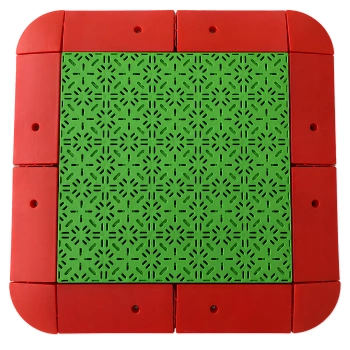
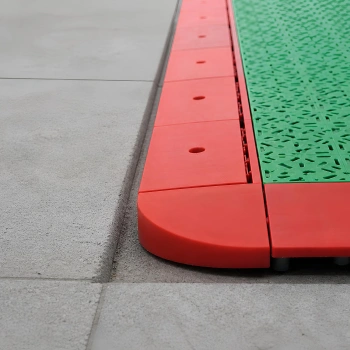
The technical polypropylene modules with perimeter interlocking offer optimized smoothness for wheels, torsional stability and minimal maintenance. The micro-texture reduces the "suction cup" effect when braking, while the calibrated interstices facilitate the dispersion of dust. It is the preferred choice when you need quick commissioning, future expansions or transport between gyms.
Versions with a lower elastic layer improve joint comfort and limit acoustic reverberation. For tournaments and leagues, it is useful to provide colored modules for technical areas and integrated lines, so as to ensure high readability and less retouching.
Synthetic Ice Hockey Floor
The polymer-based panels with very high sliding allow specific technique exercises and drills on skids, without managing refrigeration systems. They are ideal for targeted training, skill zones or temporary spaces in shopping malls. The perfectly flat joint and the intrinsic lubrication reduce parasitic friction, bringing the sensation closer to sliding on ice.
Maintenance requires regular cleaning and, when required, surface regeneration to preserve smoothness and homogeneity. A rigid and level substrate is essential to avoid perceptible micro-steps during transitions.
Indoor Pitch Flooring
Continuous vinyl or composite surfaces offer visual homogeneity and excellent noise absorption. They are appreciated in multi-sports gyms where acoustic comfort matters as much as performance. Wheel marks and light solvent-resistant finishes make post-event cleaning easy.
To increase multifunctionality, elastic layers with a high controlled friction coefficient finish can be combined, maintaining line legibility and resistance to trolleys, mobile grandstands and equipment.
Advantages of a Professional Hockey Floor
Choosing a professional surface means achieving repeatable performance and reducing the unpredictability that penalizes training and matches. The controlled rebound and frictional stability allow you to work on patterns and timing continuously, accelerating the technical growth of the athletes. At the management level, durability cuts hidden costs: fewer repairs, fewer interruptions, higher plant availability.
A quality floor mitigates impacts and supports more effective accident prevention . The system elasticity and constant flatness promote a distributed load, which is useful in intense changes of direction and contact phases.
The combination of controlled grip and springback allows for high speeds without sacrificing postural stability. Braking and restarting are more predictable, improving individual safety and team interaction. In youth sectors, these aspects promote learning and confidence, reducing stress on joints and muscles.
The consistency of the bottom reduces sudden slips and decreases neuromuscular fatigue at the same intensity, with benefits in close training cycles. The result is a more sustainable practice environment and higher average performance throughout the season.
Durability and Reduced Maintenance
Anti-abrasion materials and robust joints ensure longevity, especially in critical areas such as shooting areas and side strips. The possibility of replacing individual modules limits costs and shortens downtime. The anti-stain and anti-marking finishes facilitate routine cleaning, preserving the aesthetics and legibility of the lines.
For intensive plantations, a preventive care program keeps the surface in ideal conditions: small, constant interventions cost less than radical restorations and ensure operational continuity.
Installation and Maintenance
A successful installation starts with the analysis of the substrate: flatness, residual moisture and compressive strength define the choice of layers and the interlocking system. The design takes into account thermal expansion, junction points and areas of high traffic to ensure stability over time. On existing surfaces, pre-leveling is often the smartest investment.
The start-up phase includes functional testing, friction verification and line marking. A scheduled maintenance manual, calibrated to the sports calendar and events, extends the life of the field and keeps the technical performance unchanged.
Floor Installation and Modularity
Modular systems allow for quick and clean installations , without prolonged interruptions of operations. The perimeter joint ensures continuity, while the cut-to-size cuts guarantee perfect alignment with edges and bench doors. In the event of relocation or expansion, the modules can be dismantled and reused, protecting the investment.
Modularity also facilitates localized interventions: any damage is resolved by replacing only the area involved. In seasonal or traveling projects, this feature is a competitive advantage that reduces cost and logistical complexity.
Surface Cleaning & Care
Regular cleaning with floor cleaning machines or microfiber cloths keeps the friction coefficient constant, eliminating dust that alters braking and starting. The use of neutral detergents preserves the finish and prevents the accumulation of residues. Establishing a routine between training sessions and competitions ensures more consistent performance.
For stubborn stains or wheel marks, use compatible products indicated by the manufacturer and avoid harsh solvents. Simple attentions – such as protections under the supports of tools or mobile stands – prevent indentations and micro-scratches, prolonging the aesthetic and functional life of the surface.
Intended Use of the Hockey Floor
Each context has its own unique needs. School gyms need versatility, robustness and safety; in sports centers , the priority is continuity of use and ease of maintenance; in the arenas , uniform performance at competitive standards is sought. Conscious design ensures that the floor accompanies the sports calendar without surprises.
Defining traffic density, loads and event frequency allows you to select materials and thicknesses with the best cost/benefit ratio. The field lines and technical areas, designed with high-contrast colors, increase readability and spectacularity, improving the experience of athletes and the public.
Gyms and Schools
For the educational sector, safety, ease of cleaning and resistance to heterogeneous uses count. Modular systems with non-slip surface and good absorption are ideal for classes, indoor tournaments and extracurricular activities. The possibility of partial disassembly simplifies maintenance and seasonal adaptations.
Light colors increase brightness and visual control, while anti-marking finishes reduce the time spent removing wheel marks or tools. A balanced investment here yields educational and safety benefits for years.
Sports Centers and Sports Halls
In plants with tight schedules, the priority is business continuity. Wear-resistant materials and stable joints withstand intense cycles without yielding in flatness. Integration with perimeter guards and courtside accessories creates a coherent ecosystem that speeds up set-ups and changes of discipline.
For events, tournaments and finals, it is strategic to provide high-definition lines, dedicated colors and a cleaning plan between matches. So the field remains impeccable on an aesthetic level and constant in its performance, enhancing the show.
Professional Fields
In professional projects, maximum repeatability and precision are sought. The selection of materials is based on measurable performance: friction within narrow ranges, certified flatness, controlled absorption. The surfaces are calibrated to reduce variables and raise the technical quality of the event.
Maintenance follows strict protocols: scheduled checks, preventive replacements of high-stress modules and micro-wear mapping. The goal is to offer athletes a reliable playing platform that enhances speed, technique and tactics.
FAQ about Hockey Flooring
What is the ideal thickness for a hockey floor?
It depends on the intensity of use and the substrate. In general, modular systems with calibrated thicknesses and elastic layers offer a good balance between comfort, resistance and sliding. In professional fields, more structured configurations are chosen to ensure consistency of performance.
How complex is the installation?
The installation of the modular systems is quick and clean: with a level substrate, the perimeter interlocking allows reduced times and localized interventions in the event of expansions. For continuous surfaces, the programming includes several steps but guarantees impeccable homogeneity.
How do you keep the smoothness constant?
A regular cleaning routine, the use of compatible detergents and periodic checks of the coefficient of friction keep the behavior predictable. In the case of synthetic ice, specific regenerating treatments are provided.


 Budgets
 Dumbers
 Discs
Discs
 Benches
 Racks and Rigs
 Weights Holders
 Isotonic machines
 Calisthenics
 Cardio
 Kettlebells
 Flooring
 Gym Set
 Accessories
 Combat
 ARTI MARZIALI
 CONTAINER GYM
 Tug-Of-War
 Used Gym Equipment
 PILATES MACCHINARI
 GINNASTICA ARTISTICA
 CAMPI DA PADEL
 Prodotti in Pronta Consegna
 Informazioni
 IRONMAN
 Gift Card