If you're designing or renovating a basketball court, the basketball floor is the first element to start with. In addition to defining aesthetics and playing comfort, the surface affects the performance, safety and durability of the system. On this page you will find a complete guide to choosing, installing and maintaining your basketball floor, with practical tips and solutions for gyms, arenas and outdoor courts. You will discover differences between professional parquet and modular floors, parameters such as elasticity, cushioning and non-slip, as well as indications on costs and installation times for a truly effective investment.
Whether you run a school gym, a sports center or an outdoor court, the choice of basketball floor must be aligned with the goals: daily training, official competitions, multi-purpose use or summer tournaments. Read on for a clear and in-depth overview, so as to select the most suitable basketball sports flooring system for your project, with all the advantages in terms of performance, safety and budget.
Discounts and Promotions
Take advantage of our seasonal promotions on parquet and modularbasketball floors: discounts dedicated to schools, sports associations and PAs, with packages that include supply, installation and scheduled maintenance. Request a personalized quote now to get the best combination of quality and price.
For complex projects, we offer flexible conditions and tailor-made financing . The advantages also apply to the redevelopment and replacement of the existing basketball floor , with the collection and disposal of the old material and reduced plant downtime.
Types of Basketball Flooring
Professional parquet
Professional basketball parquet is the traditional choice for arenas and arenas: a plywood system with an elastic substructure that offers even bounce, controlled cushioning and a warm and iconic aesthetic. The surface is treated with specific finishes to ensure grip and resistance to wear, allowing quick movements and safe changes of direction. The field scales are painted in accordance with standards and dimensional stability is ensured by joints and floating systems that absorb expansion.
Parquet allows sanding and renovation over time, extending the life of the basketball floor and maintaining constant performance. It is ideal for basketball facilities and for those who aim for the highest competitive level. However, it requires proper maintenance and a stable microclimate to preserve the qualities of the wood.
Modular floors
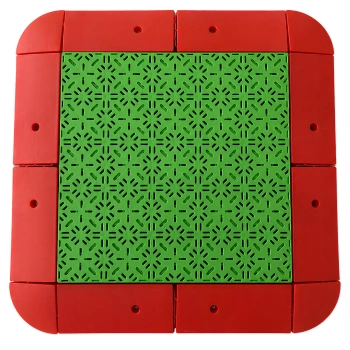
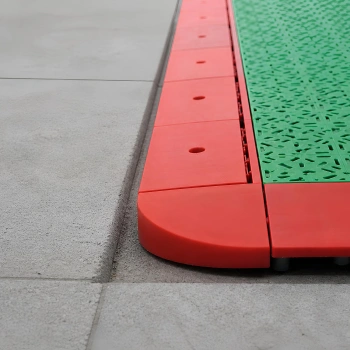
Modular basketball floors are composed of interlocking tiles in technical materials (polymers or composites) with layers of cushioning and non-slip finish. They are installed quickly, even on existing surfaces, and allow the field to be reconfigured or individual modules to be replaced in the event of damage. They offer a good compromise between performance, resistance and cost, making them ideal for multi-purpose gyms, temporary events and spaces that require versatility.
Traction-designed surface textures reduce the risk of slipping, while the underlying structure distributes loads, limiting fatigue and impacts on joints. The versions with technical top sheet simulate the feel of wood, improving the feeling of the game and the control of the ball. For intensive use, it is essential to choose modules certified for indoor sports with elasticity and shock absorption parameters in line with the practice of basketball.
Indoor and outdoor solutions
For indoors, the priority is to ensure a smooth bounce and a constant coefficient of friction , so as to promote controlled acceleration, stops and rotations. Parquet systems and modular systems with a smooth but non-slip surface offer reliable performance and manageable maintenance. Air conditioning and humidity control help keep the basketball floor in optimal condition.
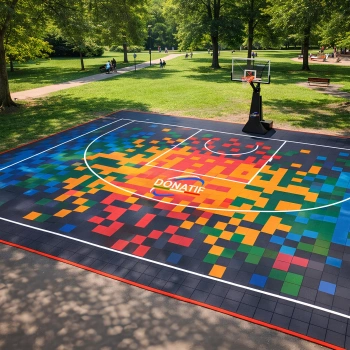
For the outdoors, resistance to UV rays, rain and temperature changes come into play. The draining modulars allow you to play safely by evacuating water and keeping the surface dry more quickly. The sun-stabilized finishes prevent discoloration and loss of performance, while the fixing systems ensure stability even on existing substrates.
Technical Features and Performance
Elasticity and cushioning
The elasticity of the flooring affects the speed, control and comfort of the athletes. A calibrated cushioning construction reduces stress on the knees and ankles, maintaining responsiveness when changing direction. In basketball parquet systems, the combination of elastic substructure and wood thickness determines the response of the court.
In modular basketball floors, elastomeric layers or micro-structured air chambers distribute impact energy. The result is a balance between shock absorption and thrust return, ideal for prolonged training sessions and close matches without excessive fatigue.
Anti-slip safety
The coefficient of friction is crucial to prevent slipping, especially in the presence of sweat or humidity. The micro-texture finishes offer grip without penalizing the glide of the foot, allowing fluid movements and controlled stops. A non-slip basketball floor maintains performance even after many hours of play.
Safety also depends on surface continuity and no unevenness. Tightly connected joints, perfectly aligned modules and professional paint finish reduce critical points, protecting athletes during jumps, fallouts and contact.
Strength and durability
A basketball floor must withstand wear and tear, shoe marks, and repeated impacts from the ball. Quality materials and specific protective layers preserve appearance and functionality, reducing interventions in the long term. In parquet, the essence and the finish make the difference; In modular cases, the density of the polymer and the strength of the joints count.
Durability is also measured in the ability to maintain flatness and technical parameters over time. Well-designed systems remain stable, do not deform and continue to provide uniform bounce, grip and playing comfort for many years.
Installation and Maintenance
Professional installation
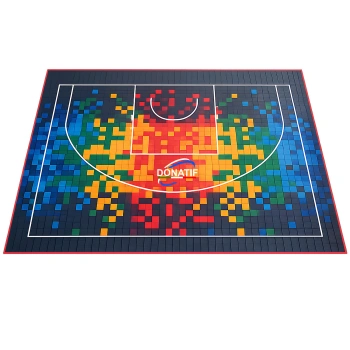
The correct installation of the basketball floor begins with the evaluation of the substrate: flatness, humidity and rigidity are decisive parameters. For parquet, the choice between floating installation with an elastic substructure or anchored systems depends on the intended use and performance requirements. Lines are traced and painted to standard, ensuring pinpoint accuracy on area, three-point line and bezel.
In modular floors, the quick interlocking allows quick installations and targeted interventions even when the system is open. The ability to work on existing surfaces reduces costs and time, avoiding demolition. In all cases, it is essential to rely on specialized teams to ensure performance and compliance.
Daily cleaning and care
A simple and constant maintenance routine preserves adherence and hygiene. Dust removal, neutral detergents and well-wrung cloths are enough to keep the basketball floor in ideal condition. Avoid aggressive products that can alter finishes and grip.
Periodic verification programs – joint control, finish inspection, possible retouching of the lines – maintain the standard of play. For parquet, sanding and painting cycles restore uniformity and safety; For modular modules, the replacement of individual elements limits costs and downtime.
Basketball Flooring for Different Structures
School gyms
In schools, the key word is versatility. A modular basketball floor with good cushioning and a non-slip finish handles physical education hours, tournaments and extracurricular activities well. Simplified maintenance helps staff maintain cleanliness and safety every day.
Resistance to marks, shocks and intensive use makes the difference on annual cycles with thousands of students. For schools hosting school championships, a parquet floor with an elastic substructure can elevate the quality of play, while still maintaining sustainable management.
Sports centers and arenas
In arenas, where basketball is the main sport, professional parquet remains the reference choice for performance and image. The combination of perfect bounce , constant grip and pleasant acoustics creates a high-level experience for athletes and audiences.
When the structure is multifunctional (volleyball, futsal, events), you can opt for premium modular solutions with a technical top, so as to guarantee versatility without sacrificing quality and safety. The ability to cover or disassemble parts of the pitch makes it easier to manage busy calendars.
External fields
For outdoor playgrounds and sports centers, the choice falls on outdoor floors with draining and UV-stabilized surfaces. The goal is to ensure grip and comfort even in variable conditions, reducing the risk of puddles and slips. The modules adapt to existing substrates, speeding up the time to play.
These solutions are ideal for summer tournaments, community activities and informal training. The possibility of replacing individual panels protects the investment, keeping the basketball floor always efficient and safe.
Prices and Purchase Basket Flooring
The cost of the basketball floor depends on the technology, materials and complexity of the construction site. Parquet requires a higher investment, repaid by top performance and long life; Modular floors allow for more cost-effective access and quick installation times. In the budget it also considers the preparation of the substrate, line marking, accessories and scheduled maintenance .
To optimize your spending, consider a complete package that includes supply, installation and service. A single technical partner simplifies management and ensures uniformity of responsibility. Request a quote indicating the type of system, hours of use, any multi-purpose and desired use in terms of performance: you will receive a targeted, transparent and sustainable proposal.
Frequently Asked Questions (FAQs)
What is the main difference between parquet and modular basketball flooring?
The parquet offers the ultimate in bounce and playing feel, with an elastic substructure that guarantees controlled cushioning and the possibility of sanding over time. The modular floor favors versatility, quick installation and simplified maintenance, with very good performance for training, schools and multifunctional facilities.
How long does a basketball floor last and how does it maintain?
The duration depends on the materials and intensity of use. A well-maintained professional parquet can last many years thanks to scheduled maintenance cycles; A modular one allows punctual replacements without invasive interventions. Daily cleaning with neutral detergents and periodic checks keeps grip and safety constant.
Can a basketball floor be installed on top of an existing surface?
Yes, especially with modular floors, which are often laid on suitable substrates without demolition. Parquet can also be installed after checking flatness and humidity, choosing the most suitable installation system. In both cases, it is essential to rely on qualified professionals.


 Budgets
 Dumbers
 Discs
Discs
 Benches
 Racks and Rigs
 Weights Holders
 Isotonic machines
 Calisthenics
 Cardio
 Kettlebells
 Flooring
 Gym Set
 Accessories
 Combat
 ARTI MARZIALI
 CONTAINER GYM
 Tug-Of-War
 Used Gym Equipment
 PILATES MACCHINARI
 GINNASTICA ARTISTICA
 CAMPI DA PADEL
 Prodotti in Pronta Consegna
 Informazioni
 IRONMAN
 Gift Card